(originally posted on June 7, 2010)
Buzz Dixon is a writer, specializing in animation. With a career that has involved him with such animation giants as Hanna-Barbera, Ruby-Spears, Filmation, Sunbow Productions, Marvel Productions, Walt Disney Television Animation, and Warner Brothers Studios, he has contributed to some of the most memorable animated television shows of the 1980s and early 90s. From G.I. Joe and The Transformer to Scooby Doo and Chip N’ Dale, all of them been graced by the unique touch of this master craftsman.
Mr. Dixon’s career has also extended to motion pictures and graphic novels. I have been fortunate enough to speak with Mr. Dixon today about his life, his career, and where it’s going.
Lone Fan: To begin with, what inspired you to become a writer?
Buzz Dixon: Parents, a grandmother, and an aunt who read to me as a child. I was mesmerized by stories and with comic books. I could remember which dialog was supposed to go with which panel even though I couldn’t read yet. I was interested in writing and telling stories at a very early age; in fact, the first “book” I ever wrote was at age 5. I drew a bunch of dinosaur pictures where I painstakingly copied their names out of books I had, even though I hadn’t been taught my ABCs yet! I stapled the whole thing together when it was done.
Lone Fan: You've worked in several mediums but your animation credits appear to be the most numerous. Did you set out to become a cartoon writer or was it something that just happened?
BD: When I left the Army in spring of 1978, I was accepted into USC’s film school. However, film school didn’t start until fall, so I decided to get a job at a studio as a driver or working in a mail room until classes began. I began at the top -- Universal, Warner Bros, etc. -- worked my way down past Samuel Z. Arkoff (I never met him but I heard him bellowing) and finally ended up at Filmation Studios, which was the penultimate bottom rung on the Saturday morning ladder at that time. I walked in the front door just about the same time producer Lou Scheimer was saying, “We need to find another staff writer and fast!”
I met Art Nadel, the producer/director of Filmation’s live action shows, while looking for a job as a driver. When he learned I had been a newspaper editor and a public affairs specialist for the Army, and had written a number of short stories (none of which had sold at the time), he asked if he could see some of my stories. He also mentioned a show they were working on where they were having problems coming up with story ideas and hinted (since he couldn’t actually ask without violating WGA rules) I could pitch some ideas to that.
I brought a batch of short stories the next day and after the weekend some story ideas for the series he mentioned. Art showed my story ideas to Lou, who said, “I don’t know if we should hire this guy or the guy last week who wrote the short stories.” Art said: “They’re the same guy” and Lou said: “Get him!”
So I ended up as a staff writer at Filmation Studios and never made it to USC’s film school!
Lone Fan: Were there any cartoons that inspired you in your work?
BD: I was already aware of Japanese animation prior to working at Filmation Studios, and while at Filmation I met members of the Cartoon Fantasy Organization, one of (if not the) very first anime/manga fan groups in America. I was greatly impressed by the depth and complexity of Japanese story telling (and their giant robots as well, to be perfectly honest) and tried to bring as much of that as I could to the stories I wrote.
Lone Fan: Which writers do you draw the most inspiration from?
BD: My tastes have changed over the years, which is not to say any particular writer is better or worse than another, just that I find different writers speak to my better at some times than others. My earliest preferences were Ray Bradbury and H.P. Lovecraft, and the stories I wrote as an early teen were pretty much pastiches of either of them. By the time I was drafted in 1972, my tastes had shifted to include Theodore Sturgeon, Alfred Bester, and Harlan Ellison. As I grew more serious about my writing, I broadened my reading and went back to “re-learn” Dickens (who I think is the best character writer ever) and other classic and/or mainstream writers. I have always liked Mark Twain and I’m a huge, HUGE fan of H. Allen Smith, a humorist from the 1940s to 1960s who is unjustly overlooked today. Among contemporary writers I like James Elroy’s sparse and direct style. Recently I’ve come full circle and rediscovered Bradbury, who may be the single best short story writer ever.
Lone Fan: Lou Schiemer is sometimes seen as the Roger Corman of animation. To some he's a genius, to others he's a hack. He developed a system to produce animation in the US without outsourcing by reusing stock footage and other corner cutting methods. Some people see that as simple economy, others as a blatant crime against cartoon art. What are your feelings on the process? Do you see it as a good thing, in that he was able to employ more people in house or a bad thing in that it hindered the final outcome of the production?
BD: There’s no reason it can’t be both economy AND a crime against cartoon art. Seriously, Lou is a sweetheart, a wonderful, wonderful guy who put up with a lot of crap from me and gave me a chance to learn the basics of my craft. He ran a very tight, economical business model that worked so long as everybody in the process knew the limitations. As a result, the shows tended to be more character driven since dialog was easy to animate, and we were encouraged to use stock footage as much as possible. They actually handed the writers on some shows big thick books of stock footage storyboards and told ‘em to assemble the shows around as much of the footage as possible.
Years after leaving Filmation I came back and did a freelance episode of “Bravestarr” for them called “The Ballad of Sara Jane”. I have taken great pains NOT to look at any other episodes, just mine, so I won’t be disappointed in seeing how much of the show was stock footage!
As for it being a “good” or “bad” thing, it was a dramatic restriction. It taught us to construct stories where we couldn’t buy our way out of a corner by ordering scads of new animation. Insofar that it encouraged ingenuity and a more thoughtful approach to story telling, it was a good thing.
Lone Fan: What was your take on Mr. Schiemer himself? Was he easy to work for, or not? Was he controlling, or did he give you a certain amount of creative freedom?
BD: Lou is a great guy and as long as the scripts weren’t expensive or likely to raise the ire of the networks’ high sheriffs, he let us do what we liked. I almost introduced sex to Saturday morning. He was going to do a series about twin girls who were superheroines and I pitched a story (which he and the network accepted) in which the girls went after a unicorn. One sister couldn’t get near the unicorn while the other one captured it quite easily. Unfortunately, the series was cancelled before it even got into production.
Lone Fan: What were his views on animation in general? I know from a comment I heard Paul Dini make concerning his tenure on "He-Man and the Master of the Universe" that Mr. Schiemer preferred for the villains to be seen as comical and not especially threatening. Did you ever have an experience like that, where he asked you to tone a story down?
BD: Well, my instincts with fantasy adventure (which by my definition includes superheroes in particular but also spy thrillers, sci-fi, sword & sorcery, or any larger-than-life story) is that the basic premise is absurd, so you might as well run with it. Now, by “absurd” I don’t mean ridiculous or even necessarily “funny”. If one starts thinking too logically about Indiana Jones or James Bond or Batman or Tarzan or any of a thousand other heroic characters, one finds big gaping plot holes in the logic. To mangle metaphors, trying to fill in the plot holes only opens a can of worms, which then requires an even bigger can of worms, etc., etc., and of course, etc., so at some point one might as well say, “okay, this is how this world operates and everybody in it accepts it” and then move on.
As a result, while I don’t wink at the audience and only rarely play it tongue in cheek (and even then, usually for a very specific reason), I do let ‘em know that anything can happen in my stories so long as it doesn’t violate the central premise of that title.
A show today that does this sort of thing absolutely perfectly is “The Venture Brothers”. It’s a comedy-adventure and they send up the cliché’s of the genre superbly, but they play their world absolutely straight and no matter how absurd it seems to us in reality, they never violate the precepts that they operate under.
Lone Fan: In regards to Mr. Dini’s comment, do you feel that Mr. Schiemer was merely being consciences, or that he was trying to dumb down the final product under the auspices that it was simple children's entertainment?
BD: Filmation shows looked cheap, but their scripts and characters were far and beyond anything done at Hanna-Barbera or any other TV animation studio at the time. There was complexity of plot, character, and motives that made the characters at least two-dimensional instead of just a cluster of catchphrases. Lou’s economizing forced us to write better, and the reason the shows are fondly remembered to this day is that they didn’t dumb things down for the kids watching them.
Lone Fan: The earliest credit I can find for you as a writer was on a show called "Tarzan and the Super 7". I tried digging up some information on the show, but wasn't able to uncover much. Could you tell us about the show and its premise?
BD: It was a logistical nightmare. There was no configuration of characters that ever totaled “7” -- if one counted teams as a single entity, then there were fewer than 7, and if one counted the characters individually then there was over a dozen. Further, there were changes made in costumes and characters up to the last minute before the shows went on the air. The aforementioned superheroine twins were meant for this show but they were ditched. “Web Woman” originally had a cool and somewhat plausible looking costume but at the last minute they decided she looked too much like Marvel’s Black Widow so they gave her a silly leotard which undercut the slightly more serious tone of the stories. Lou and his lawyer got beat up regularly by attorneys for DC, Marvel, and other comic books/comic strips who were trying to drive all competition out of business. For example, if I recall correctly, both Marvel AND DC sued over “Manta and Moray”, claiming they were too much like Sub-Mariner AND Aquaman. Ditto “Super-Stretch and Microwoman”, whom they sued for being too similar to the Elongated Man/Mr. Fantastic and the Atom/Ant-Man.
Lone Fan: What were the details of the episode you wrote, which was called "The Robot"? What was the overall plot and which characters from the show were involved?
BD: As I mentioned earlier, I was greatly impressed by Japanese animation and saw the appeal of giant robot stories long before anyone else did. I had wanted to do a nod towards Japanese animated robots, but the final design in “The Robot” looked kinda clunky and Jetson-y. We had a team of legendary superheroes, including Isis and Aladdin, who would come together whenever there was an emergency at any point in history.
See? That’s an example of the absurdity I was speaking of. If one has the ability to travel through time (as these heroes did), then there’s never an “emergency” since the moment one becomes aware of a problem one can simply back track to the moment prior to the tipping point and put a stop to it. If one has a hundred crisis over a millennium, one doesn’t have to rush immediately from one to the next. “Quantum Leap” handled that by tying in the act of time travel to very specific crisis moments, but that’s all handwaveum to avoid the logic hole.
Lone Fan: You also worked on "The New Shmoo", the Shmoo of course being a character from Al Capp's classic newspaper comic strip "Lil Abner". Did you refer back to Mr. Capp's original work during your tenure on that show?
BD: Not in the slightest. It was another rip-ff of “Scooby-Doo” (or, as that sub-genre was referred to in the animation industry at the time, “three kids and a nyah-nyah”, the “nyah-nyah” being any animal or gimmick one cared to throw in). There was no connection to Capp’s creation whatsoever; I could never figure out why they wasted money obtaining the license to the character since none of the network people knew what a Shmoo was, much less the kids in the audience.
Lone Fan: "The New Shmoo" was produced by Hanna-Barbera. What were the key differences between working for Hanna-Barbera vs. working for Filmation?
BD: Better pay, better parking.
Lone Fan: Did you get to meet, Joseph Barbera or William Hanna over the course of production?
BD: I’m sure I met Joe at some point, but I think it was just in passing in the hall. My main point of contact was Chuck Menville, the story editor.
I scared the hell out of Chuck one day. H-B had a pair of three story buildings with a court yard between them; one of the buildings had a concrete lattice on the side strong enough to climb. When I would see Chuck for a story conference, I’d park, walk the length of the courtyard to get to the front reception area, then have to walk the length of the building to get back to his office.
This particular day, as I left the parking lot I saw Chuck on the phone in his second story office, his back to me. I thought, why go all the way down and all the way back when I can simply climb the lattice, so…up I went. I rapped on Chuck’s window and he almost fell out of his chair in shock. After that they posted a guard in the court yard to keep people from taking vertical shortcuts.
Lone Fan: Your next project was a comic book adaptation of a DC comics' character called Plastic Man. During your work on "The Plastic Man Comedy/ Adventure Show" did you ever research or refer back to his comic book roots?
BD: Unlike Filmation, which gave individual writing credits to each episode, H-B and Ruby-Spears originally offered only gang credits at the end of the show. So, while I worked on the show, I didn’t write any Plastic Man segments. My specialty was “Mighty Man and Yukk” which was a knock-off of “The Blue Falcon and Dyno-Mutt”.
Lone Fan: "The Plastic Man Comedy/ Adventure Show" was produced by Ruby-Spears. How did you come to work for them?
BD: I was laid off at Filmation and heard R-S was hiring. I showed ‘em my resume, did a few freelance scripts for them, then they put me on staff.
Lone Fan: Did you have any interaction with the company's founders, Ken Spears or Joe Ruby? If so what were they like and how did you relate to them?
BD: Lou Schiemer put up with a lot of crap from me but Joe Ruby had the patience of a saint. If I had been in his shoes I woulda fired myself a dozen times over. Joe and Ken are both really nice, bright guys. They’re two of the best guys in the business and my time at Ruby-Spears was some of the most fun I ever had in show biz.
Lone Fan: In 1982 you began working on "The Scooby and Scrappy Doo Puppy Hour" which was a co-production of Hanna-Barbera and Ruby-Spears. What was your role on that series?
BD: I had no memory of that show until you mentioned it. I remember co-writing some episodes with a writing partner I had for live action screenplays, but beyond that I’m drawing a presumably merciful blank.
Lone Fan: Ken Spears and Joe Ruby had previously worked at Hanna-Barbera and were even in charge of the development of Scooby Doo when the show was first created. Did their role as creators have anything to do with this joint studio effort?
BD: Boy howdy! They’re contractually not allowed to mention just how crucial they were to the creation of “Scooby-Doo” but suffice it to say without them there probably never would have been a “Scooby-Doo” show in the first place. They left H-B the following year and served as freelance story editors for a variety of ABC prime time shows before getting ABC to set them up as an animation studio.
Lone Fan: In 1983 you worked on one episode of "The ABC Weekend Special" which was a showcase for different stories each week. The episode you wrote was called the "Puppy's Further Adventures." Could you tell us a little bit about that story, and the character it featured?
BD: I worked on the series “The Puppy’s New Adventures” that was a continuation of the story from the Weekend Special, but not on the special itself. I recall it was a light, fun show and I had a good time with the story I did, but past that…nada.
Lone Fan: You wrote one episode of "Dungeons and Dragons" an animated series based on the popular role playing game. Were you a fan of the role playing game at the time you wrote the episode?
BD: I was aware of D&D but not a player. I’d been involved in some classic military and historical gaming when I was in the Army, so I was familiar with the basic game playing concept, and I was a long time reader of fantasy stories ranging from Robert E. Howard to J.R.R. Tolkien, so I grasped the concept fairly quickly.
Years later I briefly got involved with a group of D&D players at one of the studios. My character was a dwarf named Upwynde Fart-Snyffe. You see what I’m saying about embracing the inherent absurdity of a concept?
Lone Fan: Comic book writer and historian Mark Evanier was a co-developer of the television series. Did you get to meet him while working on the show?
BD: I met him while freelancing at R-S, prior to going on staff for them. Mark is another great guy in the animation business and has been one of my best friends for close to 30 years now. He’s a kind, thoughtful, generous person and on top of that a tremendously funny and entertaining writer.
Lone Fan: In 1985, the National Coalition on Television Violence issued a report against "Dungeons and Dragons" stating it was the most violent show on television. Do you feel the show was at all inappropriate or that the Coalition was overreacting?
BD: If I recall correctly, I was disappointed that we didn’t score even higher on their violence ratings. I’m sure they must’ve overlook something.
Lone Fan: "Dungeons and Dragons" was a co-production of Marvel Productions and TSR who distributed the actual role playing game. Can you define Marvel Productions for us? How big of an operation was it at the time "Dungeons and Dragons" was being made?
BD: Marvel Productions was a quasi-spinoff of DePatie-Freleng, if I recall correctly. It was a big, gutless, soulless entity whose only virtues for me were the occasional paycheck and a chance to meet and work with Stan Lee.
Lone Fan: Did the company fall under the auspices of Marvel Comics or was Marvel Comics a subsidiary of Marvel Productions?
BD: I don’t think anybody working there at the time could have told you the answer to that one. It really was a case of the left don’t know what the right hand is doing.
Lone Fan: How did you come to work for Marvel Productions?
BD: I drove a Dodge Aspen. >rimshot<
Lone Fan: What was their approach to making cartoons?
BD: Unlike Filmation, R-S, and H-B where the heads of the studios actually had some knowledge of and hands on participation in the production process, far too many people at Marvel were suits who were eager to take the money and the credit while fobbing the responsibility and then the blame on other people. Stan was reduced to pretty much a figurehead even at that time but it was always great to have a meeting with him. Other people who worked there, the ones who had not worked their way up the production ladder but who played corporate politics well, couldn’t locate their own posteriors with the aid of a Geiger counter and a plutonium enema.*
(*tip o’the hat to Michael Reaves for coming up with this line)
Lone Fan: Marvel Productions would later go on to partner with Sunbow Productions to create the animated versions of G.I. Joe, The Transformers, and others, many of whom you contributed to. Was Marvel responsible for your introduction to Sunbow Productions?
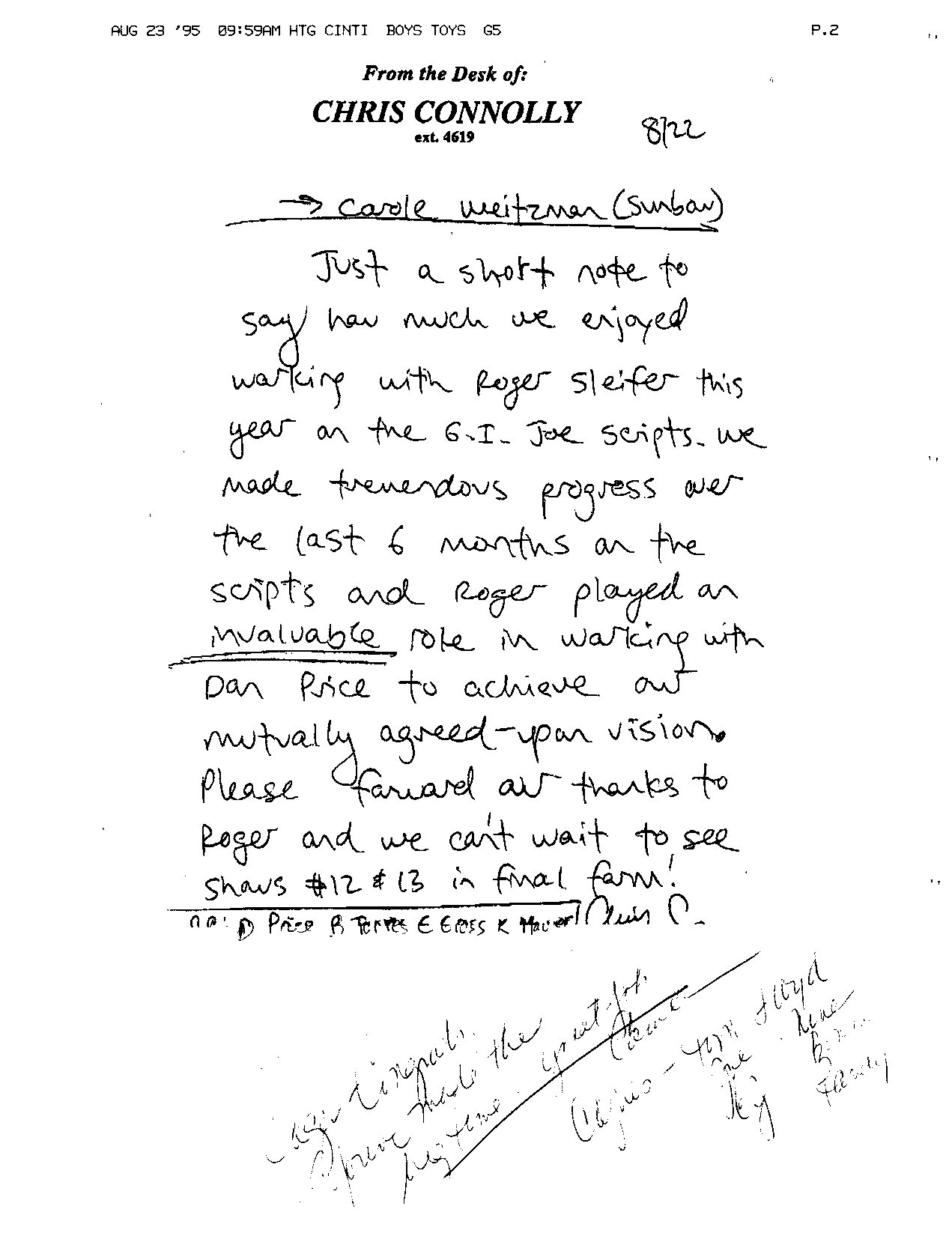
BD: No, thank heavens, because then I would have never worked on the show! I was brought aboard “G.I. Joe” by Steve Gerber, who had been a story editor at Ruby-Spears when I was on staff there. I did some freelance episodes for them, then Steve hired me to be his assistant story editor. The next year I was promoted to the story editor position on “G.I. Joe” though we would all pitch in and work on other shows in production. At the same time I was writing my episode of “Inhumanoids” I was probably also working on “My Little Pony”.
Lone Fan: During your tenure at Sunbow, you wrote three episodes of the Transformers, "Prime Target", "The God Gambit", and "Carnage in C-Minor". There were a lot of cartoons from the 80s that were popular for a time, but quickly faded away. How does it feel to have contributed to a show that people still remember and are actively interested in today?
BD: Good, but humbling. I am genuinely very happy that things I wrote are fond childhood memories for many people. I always tried to put a little bit extra in everything I did, to try to make it distinct and different. This usually meant arguing with the suits who wanted everything done in cookie cutter fashion, but if one is successful one tends to get more chances to push the envelope.
At the same time, I try not to let it go to my head. That was then, this is now. As proud as I am of what I did in the past, it is in the past. I can’t rest on what I did back then; time and tastes have changed.
Lone Fan: The Transformers were launched in 1984. That same year Hanna-Barbera launched a similar cartoon called "Challenge of the Go-Bots". Both the Transformers and Go-Bots were based on toy lines that were imported from Japan, and had back stories developed by competing American toy companies. Was there ever an attitude at Sunbow that Hanna-Barbera was in some way ripping off the Transformers idea, or that the two shows were in competition?
BD: As I mentioned before, I was the giant robot nut in the animation industry prior to the arrival of Transformers. I was aware of the various transforming mecha long before Transformers were introduced to the American market.
In fact, R-S had a show prior to both Transformers and Go-Bots called “Turbo Teen”. They had 50% of a good idea: A teenage boy who transformed into a car. If it had been a robot that transformed into a car they would have cleaned up.
Here’s another example of embracing absurdity -- and why Joe Ruby had the patience of Job when it came to me. Joe asked me to develop some episode ideas for “Turbo Teen” and gave me the bible of the series to read. I came back and said, “Okay, I’ll work up some ideas if you explain a few things to me: If he turns into a car and they remove his tires, when he changes back is he minus his hands and feet? If he turns into a car and they remove his engine, when he changes back is he minus his heart? If they put a suitcase in his trunk when he’s a car, when he changes back is it in his -- “
“We’ll move you to another show,” Joe said.
The problem with “Turbo Teen” is that they never found the right note for the show. It could have worked as an utterly absurdist Archie-type story, or it could have worked as a straight adventure show, but they never decided on which tone to take. As a result they squandered a chance to be out in front on the transforming robot craze.
Sunbow came to Joe and Ken before selecting Marvel as the production studio; they had visited all the animation houses looking for a good production partner.
Lone Fan: Having worked previously at Hanna-Barbera, did you have any friends who were working on "Challenge of the Go-Bots" at the same time you were writing for "The Transformers"?
BD: I’m pretty sure I did, but we didn’t keep track of what they were doing. We had a buncha 65 episode freight trains we had to tend to!
Lone Fan: One of the more memorable bits about the episode "Prime Target" was that it featured a brief cameo by a member of the October Guard from G.I. Joe. Were there ever any plans to do a crossover between the two shows?
BD: Oh, there was more than that! I created the character Hector Rameriez, a Geraldo Rivera-style TV journalist, for “G.I. Joe” and once the character was vetted by Hasbro’s legal department, he became the de facto news source for all Sunbow shows since it was easier just to plug him in than to create a new minor supporting character. So Hector is the link between “Joe”, “Transformers”, “Inhumanoids”, and even “Jem”!
Lone Fan: The villain from "Prime Target" is a human named Lord Chumley. Supposedly he was an original character you developed for a comic book project that never got off the ground. Is that correct?
BD: Did he end up being called Lord Chumley in the final version? I remember naming him Baron Steygar originally but since I didn’t story edit the “Transformers” series, it could have been changed. I had come up with a far future sci-fi version of “The Most Dangerous Game” as an idea for a live action movie, but never got any further than jotting down some initial notes. When we needed a “Transformers” story I threw my movie idea into service, changing the characters to robots.
Lone Fan: Your next Transformers episode, "The God Gambit" dealt with a primitive alien species mistaking the Autobots and Decepticons for gods. This was a very mature topic for a cartoon. Was it just another story idea or were you trying to elevate the subject matter for a more adult audience?
BD: I always tried to add something more to a story than the standard babyface vs. heel* storyline of most animated shows of that era. I am a Christian and matters of faith are very important to me, but I am also distressed when I see crooks and con men clothing themselves in religion to pass off their schemes, or when fellow believers turn off their critical faculties and refuse to face facts and re-examine their own beliefs. So, yes, this was very much a deliberate effort to elevate the story line into something more than the standard fight-chase-fight plotting of too many shows of that era.
(*little pro wrasslin’ lingo for ya)
Lone Fan: You worked as a writer and a story editor on the G.I. Joe animated series for Sunbow and Marvel Productions. G.I. Joe dealt with a very real issue for the time, that of military action against terrorists. The cartoon also took a somewhat tongue in cheek approach to its material. Do you feel that approach was necessary to soften the blow of the much harsher reality its premise was based on?
BD: Well, this goes back again to what I was saying about embracing the absurdity of a concept. First off, Cobra technically is not a terrorist organization. Terrorist organizations have clearly stated agendas; there’s no point in terrorizing anyone unless they know why, is there? Secondly, almost nothing Cobra did ever fell into the category of terrorist activity; i.e., assassinations, kidnappings, bombings, etc. Virtually everything they did was a large scale military operation involving hundreds if not thousands of combatants. Those are company and battalion size units, not small cells of three or four guys who get together every Friday night to make pipe bombs in the basement. You got any idea the size of the logistical support needed to keep a hundred combatants in the field? At least 600 support troops, and that’s not counting the personnel who build the equipment, obtain the material to make the equipment, etc. There’s no way an organization the size of Cobra could come into existence, much less operate at the level of activity it does, without the overt support of a major world power.
But of course we couldn’t have that, because then everyone would accuse us of war mongering against the Soviets (which they did anyway, but that’s a different topic). For Cobra to operate at the troop levels of the show, with elaborate technical support, and not have a “safe haven” territory where they could retreat without fear of betrayal or attack is ridiculous.*
Nonetheless, those were the cards we were dealt. The question that flows logically from the premise is how does an operation like Cobra continue operating without a large civilian population supporting it? Well, obviously they’ve got to have alternate sources of income, they’ve got to be knocking off banks and service stations like nobody’s business, they’re doubtlessly smuggling all sorts of illegal material we couldn’t discuss at the time, and when times get really rough they’ve gotta have a telethon to raise money.
Now, the trick is, how does one do this with just straight enough a face that the audience can suspend their disbelief for half an hour? Like a Hitchcock movie, it doesn’t have to stand up to scrutiny once “The End” flashes on the screen, but it’s got to be absolutely engrossing while it’s unspooling.
I’m pretty sure I was the only writer on the show who ever had any military experience. At first I was there just to provide a patina of verisimilitude to the proceedings: Make sure the characters acted like they did belong in a military unit, that they did operate under standard military discipline and courtesy, that they did understand what a chain of command was.
But there were other problems. The writer of the first two mini-series, Ron Friedman, is a very gifted and talented writer, but not only was he unaware of basic military protocol, he had no idea how the weapons and equipment actually worked, much less how they were actively deployed in the field. Case in point: In the first mini-series, he had Joe jets swooshing down from the sky to slash Cobra tanks in half with their wings. I can tell you how such an encounter would play out in the real world, and it wouldn’t be a happy ending for the pilot.
One reason Steve Gerber wanted me aboard was that I could supply first hand knowledge to balance out some of the more far fetched concepts. Again, going back to the idea of embracing the absurdity, when one accepted the background limitations imposed on the show by Hasbro and tried to filter it through a veneer of realism, it ends up pushing the storylines in certain directions.
As a result, we ended up with some pretty wild but pretty entertaining stories (if I do say so myself). I’d like to think we delighted and surprised our audience, but we never tricked ‘em or lied to ‘em.
(*I’m aware Larry Hama dealt with this in the comic book, but we considered the comic book to be a separate continuity from the TV series)
Lone Fan: G.I. Joe began its first regular season the same year that the NCTV issued its report against “Dungeons and Dragons”, a show which was also produced by Marvel Productions. Did the presence of that report have anything to do with the slightly comical approach to the material that Sunbow chose?
BD: No, the off-kilter POV was entirely the writing and editorial staff. Besides Steve Gerber and myself there was Flint Dille, a screenwriter and game designer, long time comics pro Roger Slifer, Doug Booth, Mike Hill, and literally dozens of tremendously talented screen, TV, and comics writers. Hasbro just wanted x number of product promoted in each episode; as long as we didn’t do anything to arouse negative attention from parents they let us do what we wanted.
Lone Fan: "G.I. Joe" was also very political, taking pot shots at anti-military newscasters, portraying French government officials in an arrogant light, and even went so far as to parody the coddling of criminals by the prison system. Was this approach something that evolved or was their a certain social outlook that the series wanted to portray?
BD: The political POVs of the writing and editorial staff ranged from hard right to far left. We’d argue politics and social issues all the time, but we respected one another’s abilities as creators and our willingness to debate points instead of just sticking to dogmatic, unbending positions. Steve and Flint are probably two of the four best friends I’ve ever had in my life, yet I don’t think one could have found two more diametrically opposed culturally and politically personalities if one looked.
Lone Fan: What were your duties as a story editor for "G.I. Joe"?
BD: To fix the two things I hated the most in each script, slap a bow tie on it, and kick it out the door. We had to turn in five half-hour scripts a week per show in order to stay on schedule. At one point I think we had a grand total 118 script commitments for various shows, all due in a twenty-four week period.
Lone Fan: As story editor how much influence did you have over the show as a whole?
BD: In retrospect, probably quite a lot. Once I was trusted not to embed pornographic messages or tout rival products* they generally let me do whatever I thought would be an interesting story, and I generally let my writers do anything they felt passionate about. I’m happy that I gave a number of writers their first shots and that they all turned in sterling work for us.
(*That’s a JOKE, people)
Lone Fan: How many story editors did G.I. Joe have?
BD: I think it was Steve Gerber, myself, and two others the first season (65 episodes) and myself alone for the 2nd season (25 episodes + 5 part miniseries + re-edited Joe movie).
Lone Fan: I've heard that "G.I. Joe: the Movie" was originally being prepared for a theaters, but was released straight to video after "Transformers: The Movie" and "My Little Pony: The Movie" failed to perform at the box office. Is that true?
BD: Yes. Afterwards a couple of people told me. “We should have released them in reverse order”. The “My Little Pony” movie did well, but there were some discrepancies about promised playdates, then the brouhaha over the death of Optimus Prime in the “Transformers” movie, and by that time the relationship with the distributor had soured so except for a special screening at that year’s San Diego Comic Con, it never played inside a theater.
Lone Fan: You were the story consultant on "G.I. Joe: The Movie". How much influence did you have on the final screenplay?
BD: I wrote the screenplay. Ron Friedman had been hired to write the original script but with the exception of one character, the flying villain, nothing he came up with was used. However, he had a good agent, and since animation was not covered by WGA rules he managed to get sole screenwriting credit even though the script was actually written by me. I bear him no grudge; he had a savvy agent who looked out for his best interests.
Lone Fan: How did the movie evolve? Was it always going to be an introduction for Cobra-La or were there other ideas that were brought forth before the final direction was taken?
BD: I feel like a character in a Merle Haggard song: “I paid the debt I owed ‘em / But they’re still not satisfied”.
Here’s what happened (and it goes back to what I was saying about the inherent absurdity in certain ideas): At the start of the second season I proposed a story that would have been called “The Most Dangerous Man In The World”. The premise was that Cobra had been holding a mysterious prison in isolation in a secret cell; when he escapes Cobra immediately suspends all operations around the world and begins an intensive search for him. The Joes also begin searching, not knowing who the prisoner is but figuring he must be potentially harmful to Cobra. They get him first and discover he is the Karl Marx / Friedrich Nietzsche of Cobra, the man who created their basic philosophy but who, when he saw how Cobra Commander was misapplying it, criticized Cobra’s leadership and earned their enmity since he’s the only one capable of invalidating their whole raison d’etre. The Joes soon learn he is a prickly and obnoxious sort and in the end when he escapes from them they let him go, figuring he’s more of a threat to Cobra than he is to the rest of the world.
To my delight, Sunbow and Hasbro accepted the idea but before I could begin work on it they told me there was a new character being added to the line-up: Cobra Emperor a.k.a. Serpentor.
I said, “Excuse me?” and asked how he fit into the Cobra chain of command. He’s the supreme leader, they said. I said, “Excuse me?” again and pointed out that we had done nothing to date to indicate there was anyone above Cobra Commander in the line-up and that we couldn’t very well drop him in without explanation. They mulled it over and told me to come up with a suitable origin.
So I developed two ideas. The first, the one I favored, would have Cobra create Serpentor from the DNA of history’s greatest military leaders as a replacement for Cobra Commander’s ineptitude. The other was that there was a heretofore unknown larger, even more secret organization that used Cobra as a pawn. I turned both ideas in. A few days later they called and said great, do it. “Which one?” I asked. Both, sez they.
Well, that pretty much torpedoed “The Most Dangerous Man In The World” because if Cobra was founded and secretly run by a mysterious organization, they wouldn’t go about drawing attention to themselves by proclaiming their philosophy.
So the creation of Serpentor became the plot for the 2nd season opening mini-series, and the story of the super secret organization behind Cobra would become the movie. Now the question became one of where the super secret mysterious organization was located. Since Sunbow and Hasbro didn’t want this organization to be identified with any known country, I suggested it be located in some remote part of the world like Antarctica, the Sahara, or the Himalayas. They liked the Himalayas and then I made my fatal mistake: So that we would know what we were referring to when we wanted to talk about the secret organization, I gave them a placeholder name of “Cobra-La” thinking surely no one would accept that as the final name.
Guess what: They did. (My advice to other writers is never ever come up with a placeholder name you’re not prepared to live with.)
From that point on, the movie plot flowed pretty easy. It had to mesh with the mini-series, but we’d allowed for that and dropped some hints in those episodes. The biggest change was turning Golobulus from a Nero-esque / Charles Laughton-style villain to a bizarre freak of nature. My original intent had been to present him as a big, soft, somewhat effeminate leader who was waited on hand and foot, yet when the time came for him to engage Sgt. Slaughter in hand-to-hand combat, he’d prove incredibly fast, agile, and strong. This idea was vetoed because of concerns he might come across as a homosexual.
I also came up with the battle cry of “Cobra-Lalalalala” based on the ear piercing warning of the Bedouin women in “Lawrence of Arabia”. If you’ve seen that film, you’ll know they had an incredibly loud, trilling shriek that was unnerving and unearthly. Unfortunately, the actor selected to play Serpentor was Dick Gautier, a very fine performer but one with a voice about four octaves too deep to do “Cobra-Lalalala” justice. I wasn’t able to prevent them from using the battle cry since they had already recorded several characters screaming it.
So there you have it: Mea culpa, mea culpa, mea maxima culpa.
Lone Fan: Duke was originally supposed to die in the movie, but the outcry over the death of Optimus Prime in "Transformers: The Movie" caused Sunbow to rethink that position. How did you feel about killing Duke? Did you think it was a good move or was there some part of you that was against the idea?
BD: A legitimate criticism against the original mini-series was that no one was ever hurt, they always ejected or jumped free just before their vehicle exploded. When I started writing and then editing for the series, I insisted there be at least some reference to injury in every episode if we couldn’t have anyone die. Someone always gets seriously hurt in the shows I had a hand in. I also had the Joes refer to “casualties” figuring (correctly) that neither Sunbow nor Hasbro would realize that meant dead and wounded.
For the movie I argued successfully (at least originally) for Duke’s death: It was logical, it would be emotionally moving, and it would blunt possible criticism of the movie glorifying violence while minimizing the consequences. Unfortunately, Hasbro decided if one hero dying was good, two heroes dying would be even better and so ordered Optimus Prime to die in the “Transformers” movie.
Now, again this goes back to embracing inherent absurdities. If a character is a robot, as George Lucas has repeatedly pointed out, one can smash ‘em, bash ‘em, trash ‘em, slash ‘em, and splash ‘em all one wants: Robots can always be re-built, their personalities and memories downloaded to a new body. “Death” for a robot is an inherently absurd concept, and in the context of a series where robot characters get trashed and repaired regularly, one that violates the basic premise of the show.
It also shocked a lot of younger kids who came to see the “Transformers” movie. “Transformers” audiences tended to skew somewhat younger than “Joe” viewers; I believe the median age was 9 instead of 12. Nine year olds had to see “Transformers” with their parents, who were made uncomfortable when their sons’ hero dies. The “Joe” audience, being older on average, would be better prepared emotionally for Duke’s death and probably wouldn’t have their parents present in the theater.
After the “Transformers” movie traumatize a significant portion of its audience, Hasbro order Duke’s death scene to be changed with a very clumsy dialog overlay. If one watches the film without sound, it’s pretty obvious he’s died, but a dubbed in line assures us he’s just “in a coma”.
Lone Fan: “G.I. Joe: The Movie" was the last G.I. Joe project released by Sunbow. Afterwards the series was continued by DIC. How did Sunbow lose the rights to the property?
BD: DIC is known in the animation industry as Do It Cheaper. They significantly underbid Sunbow and Marvel for the 3rd season of “Joe” and other series. The suits I talked to at DIC at roughly that time about another project proved themselves to be interested only in lining their own pockets with no interest whatsoever in quality. The DIC suits appeared to be openly contemptuous of their audience. I never watched any of their Hasbro related shows, but other programs I saw later were about as insulting to viewers as can be imagined.
Lone Fan: If Sunbow had been allowed to develop the series after "G.I. Joe: The Movie" would Cobra-La have replaced Cobra as the main opposition to the Joes?
BD: Mike Hill came up with a really cool idea about the remnants of Cobra forming a new, leaner, meaner organization called The Coil, but that idea died a’borning when DIC took the series over.
Lone Fan: Now that G.I. Joe is finally being released on DVD, can we expect to see you on any of the special features?
BD: I’m in the phone book. All they gotta do is ask.
Lone Fan: Getting back to another Hasbro/ Sunbow collaboration, let's talk about "My Little Pony: The Movie". You were the Associate Story Consultant on that project. How much control did you have on the final outcome of that feature?
BD: Relatively little. The basic plot was already in place; I just story edited it to make sure the plot flowed smoothly. I think I also suggested areas where musical numbers could be inserted.
Lone Fan: Something that always bothered me about "My Little Pony: The Movie" is that there seems to be more focus on the villains than there is on the Ponies themselves. Many of the best scenes from that feature focus on the witches who are trying to drive the Ponies out of the valley and the witches get as much or more screen time than the Ponies do. Was that intentional or did the Witches manage to steal the show all on their own?
BD: The problem was that instead of hiring voice actors purely on ability, as had been done with the TV series, they looked for big name talent. As a result they felt they had to focus on the stars’ characters as opposed to the regular series characters.
Lone Fan: One more question. I realize your involvement with the Pony franchise was limited, but I've often wondered something. The pilot episode to the series is very dark, focusing on a villain named Turrak who's every bit as evil as Megatron or Destro. The story felt like less of a fairy tale and more of a straight fantasy adventure. Why did the focus on the show go lighter with the other episodes? Do you know?
BD: Roger Slifer might be a better person to ask; while I wrote some episodes of the TV show and edited the movie script, my daily involvement was limited at best.
Lone Fan: There's a lot of talk these days about the roll toy companies played in the development of animated television during the decade of the 1980s. Sunbow produced "Transformers", "G.I. Joe", and "My Little Pony", all of which you worked on and all of which were based on popular toy lines of the day. From your own experience, was the presence of the toy companies a negative or positive collaboration?
BD: It varied. Some toy companies actually had a desire to do something worthwhile as well as sell product. Some wanted to sell product but were wise enough to find good, creative people and let them have their head. Some were cheap money grubbers and didn’t care as long as their quarterly profits kept improving.
And it was not impossible for one company to behave differently at different times for different shows. A bad quarter might make a toy company take short cuts. Conversely, Hasbro kept “Jem” going as a TV show for an additional season even after the toy line had been cancelled.
Lone Fan: How would you describe Hasbro's relationship with Sunbow and Marvel Productions? Was it an easy or tenuous partnership?
BD: Easy. I’ve worked with far, far worse people but very few better.
Lone Fan: You worked on Ruby-Spears 1988 Superman cartoon on the episode "Cybron Strikes", wherein a character named Cybron is converting humans into energy beings. At the time this series was made, the Superman comics were being completely remade from scratch. Cybron was intended to be a reworking of the classic Superman foe Brainiac since his character's final remake was still not yet established in the comics. How much input did you have in the actual creation of the Cybron character?
BD: The concept for “Cybron Strikes” comes from “The Chameleon” episode of the original “Outer Limits” series. In “The Chameleon” Robert Duvall plays a human secret agent who is transformed into an alien so he might spy on a crash landed saucer; in the end he opts to stay in alien form and go with them to their planet. The idea that some of the humans Cybron converts into energy beings might opt to help him re-create his world and people, struck me as a nice new level of complexity to add to an otherwise standard alien possession story. I was well aware of the various incarnations of Brainiac but also knew he was no longer in continuity at the time the series was being made.
Lone Fan: There was an episode of "Jabberjaw", an earlier series also produced by Ruby-Spears, which featured a character named Dr. Cybron. Was the name Cyrbon lifted from this earlier character or is its repeat usage merely a coincidence?
BD: Coincidence. The only Jabberjaw story I’ve ever seen is the one they did on “Harvey Birdman, Attorney-at-Law”.
Lone Fan: You co-wrote one episode of "Chip N' Dale Rescue Ranger" for Disney, which was called "Flash the Wonder Dog". Did you create the character of Flash or was he a preconceived character that was handed to you?
BD: He wasn’t pre-conceived by Disney Studios and handed to me, but at the same time I’m almost certain I based the idea on a cartoon I’d seen years and years ago. The basic premise of the braggart who pretends to be a hero but is really a coward is an old one, of course.
Lone Fan: Did you have any input on his visual design?
BD: Other than referring to him as a German shepherd, no.
Lone Fan: Animation Director Tad Stones of ‘Hellboy Animated’ fame and the recent feature ‘Turok: Son of Stone’ was the co-creator of Rescue Rangers and the acting script editor for the show. How big a hand did he have in the writing of your episode? I've heard reports that he was very active in terms of scripting.
BD: I think Tad’s hand is normal size. >rimshot<
Lone Fan: Did you get to meet Tad Stones during your short stay on "Chip N Dale Rescue Rangers"? If so, what was your general impression of him?
BD: I can’t recall if I actually went into the office, or if I just did business with him via phone and modem. I know he was highly recommended by other people who had worked with him before and all my memories of my “Rescue Ranger” foray are good ones.
Lone Fan: How did you get the job writing that episode?
BD: If I recall correctly, it involved a lot of begging and pleading but no outright bribery. (That’s another joke, folks.)
Lone Fan: Why did you only write one episode?
BD: That’s all I had that they liked.
Lone Fan: So, were there any other episode ideas you pitched that might have been rejected?
BD: I can't remember what else I pitched to Chip N’ Dale’s Rescue Rangers. I know one was a story involving Gadget that would have been set in Central Park. I find plotting to be fairly easy once I know who the characters are and what the central conflict is about. "Flash the Wonder Dog" hinged on Dale's hero worship of Flash. When writing for a series (TV or comics) I try to build stories around the central characters, not around guest stars/villains.
Lone Fan: Despite having been out of production for close to two decades, "Chip N Dale Rescue Rangers" has developed a very loyal cult following with several websites, its own wiki, fan databases, and several smaller personalized websites devoted to various characters of the show. "Flash the Wonder Dog" is actually one of the better remembered characters from the show. He is often mentioned, and is frequently used in fan fictions. One fan has even created a series of fan fictions that starred Flash in his own adventures. Does it ever surprise you when you work on something and come back years later to find this small stop in your life is still loved and cherished by others?
BD: Somewhat. I’m very glad for the good memories people have of my work, and if some of it has inspired others to be creative, I’m especially happy.
Lone Fan: In the early 90's you contributed to "Conan the Adventurer" an animated adaptation of Robert E. Howard's character Conan the Barbarian. Were you familiar with Howard's work prior to contributing to the series?
BD: Very much so. I’d read all the Conan stories when I was a teenager.
Lone Fan: Were you influenced by any one story of Howard's while working on the show?
BD: I think “A Witch Shall Be Born” is my favorite Conan story and if I could find any inspiration from that for the script I wrote, I would have certainly worked it in!
Lone Fan: Could you tell us a little bit about the production? Were the crew aware of the Conan mythos and did they refer back to it, or was Conan merely a template they used to re-imagine the brand and take it in a new direction?
BD: This was a case where everything was done over the phone and via the Internet. I’d worked with story editor Christy Marx in the past and thought she was a dynamite writer and editor (I wish somebody would bring her epic Amazon story “Sisterhood of Steel” back into print). Christy certainly knew who and what Conan was, but I’m sure Hasbro had their own ideas.
Lone Fan: You wrote one episode, the fourth episode in the series I believe, "Conan the Gladiator". Can you tell us what that episode entailed and what your inspiration was behind the story?
BD: Basically get Conan in trouble as fast as possible and have him hack his way clear in the most expeditious manner, to paraphrase Howard’s own advice on writing the character. I know he’d been a gladiator in other stories. Since the studio was squeamish on real swordplay, coming up with the weird battle machines gave us an opportunity for a lot of swashbuckling with no human injuries.
Lone Fan: You also wrote one episode of "Batman: The Animated Series". I read a statement from David Wise that in one episode of the show he was assigned to write an introductory story for the Riddler. Did the producers assign you characters when working on the show or were you allowed to pitch stories with any character you wanted?
BD: I actually wrote three scripts for “Batman: The Animated Series”. The first involved a brand new pair of villains, a father and daughter Eurotrash team. That got me hired, but the script was eventually put aside when they decided to concentrate on established trademarked licensed characters. The next script was “Cat Scratch Fever” which was based on a story by Sean Catherine Derek; it was good and fun and marked the beginning of Catwoman’s gradual turn from 100% bad to half and half. The third script was “Beware The Creeper” which Steve Gerber asked me to help out on since he was facing deadline pressure. I collaborated with Steve on a number of projects during the years I knew him, starting with “Destroyer Duck” and ending on “She Hulk”.
Lone Fan: You also worked on a science fiction feature in 1995 called "Dark Planet". How did you come to be associated with that production?
BD: I had known Shari Bowles, now a producer but then an office manager and production supervisor of producer-director John Eyres, for quite some time. When John wanted to do a trio of sci-fi films back to back in order to amortize production costs, he asked Shari to help him locate scripts. John had already done small promotional flyers that proclaimed the films’ titles and gave only the vaguest of descriptions of their stories. His pitch for “Dark Planet” essentially boiled down to “Ooooooh! Scary!” Shari told me what he was looking for in terms of budget and I created a story accordingly. I kept the action confined to two starships and realized that while the title was “Dark Planet” we didn’t have to actually land on it.
I tried to make a good, fast paced sci-fi action story that could be filmed as cheaply as possible. If you’ve seen the film you’ll know there are scenes where the villains monkey with the ship’s gravity and life support systems: The special effects consisted of the actors acting like they were freezing or weighed thousands of pounds! My original idea was an Afro-centric future with the hero being a token white guy, but I don’t think John felt comfortable with that so it was dropped.
Lone Fan: Did you enjoy working on it?
BD: It was fun, not a deathless classic but nice enough.
Lone Fan: In terms of animation vs. live action, what are the key differences in writing for one or the other?
BD: When I first started writing animation, everything was spelled out in explicit detail: “MOVE IN TIGHT on Papa Smurf. HOLD A BEAT while be BLINKS in surprise, then TILT UP SLIGHTLY to show Smurfette in a tree above him” would now be “Papa Smurf looks surprised. Smurfette is in the tree above him”.
Lone Fan: Do you prefer one to the other? And if so, which do you prefer to write for?
BD: I find writing comic book / graphic novel scripts to be the format I’m most comfortable with. It forces me to be concise and focused scene to scene instead of rambling on.
Lone Fan: How many pages does a script for a half hour animated series run on average?
BD: When I started, a script ran 30 seconds a page, so a half hour (actually 22 minutes sans commercial breaks) would be 44-45 pages. Now they’re the same as live action (i.e., one minute = one page) so it would be a 22 page script.
Lone Fan: What's next for Buzz Dixon? Do you have any projects in the works? What are your plans for the future?
BD: I’ve been doing graphic novels for the Christian tween-to-teen market, notably the Serenity series (not to be confused with Joss Whedon’s movie or comic books). The Serenity story will continue as a series of illustrated prose novels starting this year. A sports graphic novel, “Hits & Misses”, will launch shortly. I’ll be making a press release soon regarding my new company, Snokie, and the books we’ll be doing.
Lone Fan: Thank you so much for speaking with me. I really appreciate it, Mr. Dixon. Have a good night.
Buzz Dixon is a writer, specializing in animation. With a career that has involved him with such animation giants as Hanna-Barbera, Ruby-Spears, Filmation, Sunbow Productions, Marvel Productions, Walt Disney Television Animation, and Warner Brothers Studios, he has contributed to some of the most memorable animated television shows of the 1980s and early 90s. From G.I. Joe and The Transformer to Scooby Doo and Chip N’ Dale, all of them been graced by the unique touch of this master craftsman.
Mr. Dixon’s career has also extended to motion pictures and graphic novels. I have been fortunate enough to speak with Mr. Dixon today about his life, his career, and where it’s going.
Lone Fan: To begin with, what inspired you to become a writer?
Buzz Dixon: Parents, a grandmother, and an aunt who read to me as a child. I was mesmerized by stories and with comic books. I could remember which dialog was supposed to go with which panel even though I couldn’t read yet. I was interested in writing and telling stories at a very early age; in fact, the first “book” I ever wrote was at age 5. I drew a bunch of dinosaur pictures where I painstakingly copied their names out of books I had, even though I hadn’t been taught my ABCs yet! I stapled the whole thing together when it was done.
Lone Fan: You've worked in several mediums but your animation credits appear to be the most numerous. Did you set out to become a cartoon writer or was it something that just happened?
BD: When I left the Army in spring of 1978, I was accepted into USC’s film school. However, film school didn’t start until fall, so I decided to get a job at a studio as a driver or working in a mail room until classes began. I began at the top -- Universal, Warner Bros, etc. -- worked my way down past Samuel Z. Arkoff (I never met him but I heard him bellowing) and finally ended up at Filmation Studios, which was the penultimate bottom rung on the Saturday morning ladder at that time. I walked in the front door just about the same time producer Lou Scheimer was saying, “We need to find another staff writer and fast!”
I met Art Nadel, the producer/director of Filmation’s live action shows, while looking for a job as a driver. When he learned I had been a newspaper editor and a public affairs specialist for the Army, and had written a number of short stories (none of which had sold at the time), he asked if he could see some of my stories. He also mentioned a show they were working on where they were having problems coming up with story ideas and hinted (since he couldn’t actually ask without violating WGA rules) I could pitch some ideas to that.
I brought a batch of short stories the next day and after the weekend some story ideas for the series he mentioned. Art showed my story ideas to Lou, who said, “I don’t know if we should hire this guy or the guy last week who wrote the short stories.” Art said: “They’re the same guy” and Lou said: “Get him!”
So I ended up as a staff writer at Filmation Studios and never made it to USC’s film school!
Lone Fan: Were there any cartoons that inspired you in your work?
BD: I was already aware of Japanese animation prior to working at Filmation Studios, and while at Filmation I met members of the Cartoon Fantasy Organization, one of (if not the) very first anime/manga fan groups in America. I was greatly impressed by the depth and complexity of Japanese story telling (and their giant robots as well, to be perfectly honest) and tried to bring as much of that as I could to the stories I wrote.
Lone Fan: Which writers do you draw the most inspiration from?
BD: My tastes have changed over the years, which is not to say any particular writer is better or worse than another, just that I find different writers speak to my better at some times than others. My earliest preferences were Ray Bradbury and H.P. Lovecraft, and the stories I wrote as an early teen were pretty much pastiches of either of them. By the time I was drafted in 1972, my tastes had shifted to include Theodore Sturgeon, Alfred Bester, and Harlan Ellison. As I grew more serious about my writing, I broadened my reading and went back to “re-learn” Dickens (who I think is the best character writer ever) and other classic and/or mainstream writers. I have always liked Mark Twain and I’m a huge, HUGE fan of H. Allen Smith, a humorist from the 1940s to 1960s who is unjustly overlooked today. Among contemporary writers I like James Elroy’s sparse and direct style. Recently I’ve come full circle and rediscovered Bradbury, who may be the single best short story writer ever.
Lone Fan: Lou Schiemer is sometimes seen as the Roger Corman of animation. To some he's a genius, to others he's a hack. He developed a system to produce animation in the US without outsourcing by reusing stock footage and other corner cutting methods. Some people see that as simple economy, others as a blatant crime against cartoon art. What are your feelings on the process? Do you see it as a good thing, in that he was able to employ more people in house or a bad thing in that it hindered the final outcome of the production?
BD: There’s no reason it can’t be both economy AND a crime against cartoon art. Seriously, Lou is a sweetheart, a wonderful, wonderful guy who put up with a lot of crap from me and gave me a chance to learn the basics of my craft. He ran a very tight, economical business model that worked so long as everybody in the process knew the limitations. As a result, the shows tended to be more character driven since dialog was easy to animate, and we were encouraged to use stock footage as much as possible. They actually handed the writers on some shows big thick books of stock footage storyboards and told ‘em to assemble the shows around as much of the footage as possible.
Years after leaving Filmation I came back and did a freelance episode of “Bravestarr” for them called “The Ballad of Sara Jane”. I have taken great pains NOT to look at any other episodes, just mine, so I won’t be disappointed in seeing how much of the show was stock footage!
As for it being a “good” or “bad” thing, it was a dramatic restriction. It taught us to construct stories where we couldn’t buy our way out of a corner by ordering scads of new animation. Insofar that it encouraged ingenuity and a more thoughtful approach to story telling, it was a good thing.
Lone Fan: What was your take on Mr. Schiemer himself? Was he easy to work for, or not? Was he controlling, or did he give you a certain amount of creative freedom?
BD: Lou is a great guy and as long as the scripts weren’t expensive or likely to raise the ire of the networks’ high sheriffs, he let us do what we liked. I almost introduced sex to Saturday morning. He was going to do a series about twin girls who were superheroines and I pitched a story (which he and the network accepted) in which the girls went after a unicorn. One sister couldn’t get near the unicorn while the other one captured it quite easily. Unfortunately, the series was cancelled before it even got into production.
Lone Fan: What were his views on animation in general? I know from a comment I heard Paul Dini make concerning his tenure on "He-Man and the Master of the Universe" that Mr. Schiemer preferred for the villains to be seen as comical and not especially threatening. Did you ever have an experience like that, where he asked you to tone a story down?
BD: Well, my instincts with fantasy adventure (which by my definition includes superheroes in particular but also spy thrillers, sci-fi, sword & sorcery, or any larger-than-life story) is that the basic premise is absurd, so you might as well run with it. Now, by “absurd” I don’t mean ridiculous or even necessarily “funny”. If one starts thinking too logically about Indiana Jones or James Bond or Batman or Tarzan or any of a thousand other heroic characters, one finds big gaping plot holes in the logic. To mangle metaphors, trying to fill in the plot holes only opens a can of worms, which then requires an even bigger can of worms, etc., etc., and of course, etc., so at some point one might as well say, “okay, this is how this world operates and everybody in it accepts it” and then move on.
As a result, while I don’t wink at the audience and only rarely play it tongue in cheek (and even then, usually for a very specific reason), I do let ‘em know that anything can happen in my stories so long as it doesn’t violate the central premise of that title.
A show today that does this sort of thing absolutely perfectly is “The Venture Brothers”. It’s a comedy-adventure and they send up the cliché’s of the genre superbly, but they play their world absolutely straight and no matter how absurd it seems to us in reality, they never violate the precepts that they operate under.
Lone Fan: In regards to Mr. Dini’s comment, do you feel that Mr. Schiemer was merely being consciences, or that he was trying to dumb down the final product under the auspices that it was simple children's entertainment?
BD: Filmation shows looked cheap, but their scripts and characters were far and beyond anything done at Hanna-Barbera or any other TV animation studio at the time. There was complexity of plot, character, and motives that made the characters at least two-dimensional instead of just a cluster of catchphrases. Lou’s economizing forced us to write better, and the reason the shows are fondly remembered to this day is that they didn’t dumb things down for the kids watching them.
Lone Fan: The earliest credit I can find for you as a writer was on a show called "Tarzan and the Super 7". I tried digging up some information on the show, but wasn't able to uncover much. Could you tell us about the show and its premise?
BD: It was a logistical nightmare. There was no configuration of characters that ever totaled “7” -- if one counted teams as a single entity, then there were fewer than 7, and if one counted the characters individually then there was over a dozen. Further, there were changes made in costumes and characters up to the last minute before the shows went on the air. The aforementioned superheroine twins were meant for this show but they were ditched. “Web Woman” originally had a cool and somewhat plausible looking costume but at the last minute they decided she looked too much like Marvel’s Black Widow so they gave her a silly leotard which undercut the slightly more serious tone of the stories. Lou and his lawyer got beat up regularly by attorneys for DC, Marvel, and other comic books/comic strips who were trying to drive all competition out of business. For example, if I recall correctly, both Marvel AND DC sued over “Manta and Moray”, claiming they were too much like Sub-Mariner AND Aquaman. Ditto “Super-Stretch and Microwoman”, whom they sued for being too similar to the Elongated Man/Mr. Fantastic and the Atom/Ant-Man.
Lone Fan: What were the details of the episode you wrote, which was called "The Robot"? What was the overall plot and which characters from the show were involved?
BD: As I mentioned earlier, I was greatly impressed by Japanese animation and saw the appeal of giant robot stories long before anyone else did. I had wanted to do a nod towards Japanese animated robots, but the final design in “The Robot” looked kinda clunky and Jetson-y. We had a team of legendary superheroes, including Isis and Aladdin, who would come together whenever there was an emergency at any point in history.
See? That’s an example of the absurdity I was speaking of. If one has the ability to travel through time (as these heroes did), then there’s never an “emergency” since the moment one becomes aware of a problem one can simply back track to the moment prior to the tipping point and put a stop to it. If one has a hundred crisis over a millennium, one doesn’t have to rush immediately from one to the next. “Quantum Leap” handled that by tying in the act of time travel to very specific crisis moments, but that’s all handwaveum to avoid the logic hole.
Lone Fan: You also worked on "The New Shmoo", the Shmoo of course being a character from Al Capp's classic newspaper comic strip "Lil Abner". Did you refer back to Mr. Capp's original work during your tenure on that show?
BD: Not in the slightest. It was another rip-ff of “Scooby-Doo” (or, as that sub-genre was referred to in the animation industry at the time, “three kids and a nyah-nyah”, the “nyah-nyah” being any animal or gimmick one cared to throw in). There was no connection to Capp’s creation whatsoever; I could never figure out why they wasted money obtaining the license to the character since none of the network people knew what a Shmoo was, much less the kids in the audience.
Lone Fan: "The New Shmoo" was produced by Hanna-Barbera. What were the key differences between working for Hanna-Barbera vs. working for Filmation?
BD: Better pay, better parking.
Lone Fan: Did you get to meet, Joseph Barbera or William Hanna over the course of production?
BD: I’m sure I met Joe at some point, but I think it was just in passing in the hall. My main point of contact was Chuck Menville, the story editor.
I scared the hell out of Chuck one day. H-B had a pair of three story buildings with a court yard between them; one of the buildings had a concrete lattice on the side strong enough to climb. When I would see Chuck for a story conference, I’d park, walk the length of the courtyard to get to the front reception area, then have to walk the length of the building to get back to his office.
This particular day, as I left the parking lot I saw Chuck on the phone in his second story office, his back to me. I thought, why go all the way down and all the way back when I can simply climb the lattice, so…up I went. I rapped on Chuck’s window and he almost fell out of his chair in shock. After that they posted a guard in the court yard to keep people from taking vertical shortcuts.
Lone Fan: Your next project was a comic book adaptation of a DC comics' character called Plastic Man. During your work on "The Plastic Man Comedy/ Adventure Show" did you ever research or refer back to his comic book roots?
BD: Unlike Filmation, which gave individual writing credits to each episode, H-B and Ruby-Spears originally offered only gang credits at the end of the show. So, while I worked on the show, I didn’t write any Plastic Man segments. My specialty was “Mighty Man and Yukk” which was a knock-off of “The Blue Falcon and Dyno-Mutt”.
Lone Fan: "The Plastic Man Comedy/ Adventure Show" was produced by Ruby-Spears. How did you come to work for them?
BD: I was laid off at Filmation and heard R-S was hiring. I showed ‘em my resume, did a few freelance scripts for them, then they put me on staff.
Lone Fan: Did you have any interaction with the company's founders, Ken Spears or Joe Ruby? If so what were they like and how did you relate to them?
BD: Lou Schiemer put up with a lot of crap from me but Joe Ruby had the patience of a saint. If I had been in his shoes I woulda fired myself a dozen times over. Joe and Ken are both really nice, bright guys. They’re two of the best guys in the business and my time at Ruby-Spears was some of the most fun I ever had in show biz.
Lone Fan: In 1982 you began working on "The Scooby and Scrappy Doo Puppy Hour" which was a co-production of Hanna-Barbera and Ruby-Spears. What was your role on that series?
BD: I had no memory of that show until you mentioned it. I remember co-writing some episodes with a writing partner I had for live action screenplays, but beyond that I’m drawing a presumably merciful blank.
Lone Fan: Ken Spears and Joe Ruby had previously worked at Hanna-Barbera and were even in charge of the development of Scooby Doo when the show was first created. Did their role as creators have anything to do with this joint studio effort?
BD: Boy howdy! They’re contractually not allowed to mention just how crucial they were to the creation of “Scooby-Doo” but suffice it to say without them there probably never would have been a “Scooby-Doo” show in the first place. They left H-B the following year and served as freelance story editors for a variety of ABC prime time shows before getting ABC to set them up as an animation studio.
Lone Fan: In 1983 you worked on one episode of "The ABC Weekend Special" which was a showcase for different stories each week. The episode you wrote was called the "Puppy's Further Adventures." Could you tell us a little bit about that story, and the character it featured?
BD: I worked on the series “The Puppy’s New Adventures” that was a continuation of the story from the Weekend Special, but not on the special itself. I recall it was a light, fun show and I had a good time with the story I did, but past that…nada.
Lone Fan: You wrote one episode of "Dungeons and Dragons" an animated series based on the popular role playing game. Were you a fan of the role playing game at the time you wrote the episode?
BD: I was aware of D&D but not a player. I’d been involved in some classic military and historical gaming when I was in the Army, so I was familiar with the basic game playing concept, and I was a long time reader of fantasy stories ranging from Robert E. Howard to J.R.R. Tolkien, so I grasped the concept fairly quickly.
Years later I briefly got involved with a group of D&D players at one of the studios. My character was a dwarf named Upwynde Fart-Snyffe. You see what I’m saying about embracing the inherent absurdity of a concept?
Lone Fan: Comic book writer and historian Mark Evanier was a co-developer of the television series. Did you get to meet him while working on the show?
BD: I met him while freelancing at R-S, prior to going on staff for them. Mark is another great guy in the animation business and has been one of my best friends for close to 30 years now. He’s a kind, thoughtful, generous person and on top of that a tremendously funny and entertaining writer.
Lone Fan: In 1985, the National Coalition on Television Violence issued a report against "Dungeons and Dragons" stating it was the most violent show on television. Do you feel the show was at all inappropriate or that the Coalition was overreacting?
BD: If I recall correctly, I was disappointed that we didn’t score even higher on their violence ratings. I’m sure they must’ve overlook something.
Lone Fan: "Dungeons and Dragons" was a co-production of Marvel Productions and TSR who distributed the actual role playing game. Can you define Marvel Productions for us? How big of an operation was it at the time "Dungeons and Dragons" was being made?
BD: Marvel Productions was a quasi-spinoff of DePatie-Freleng, if I recall correctly. It was a big, gutless, soulless entity whose only virtues for me were the occasional paycheck and a chance to meet and work with Stan Lee.
Lone Fan: Did the company fall under the auspices of Marvel Comics or was Marvel Comics a subsidiary of Marvel Productions?
BD: I don’t think anybody working there at the time could have told you the answer to that one. It really was a case of the left don’t know what the right hand is doing.
Lone Fan: How did you come to work for Marvel Productions?
BD: I drove a Dodge Aspen. >rimshot<
Lone Fan: What was their approach to making cartoons?
BD: Unlike Filmation, R-S, and H-B where the heads of the studios actually had some knowledge of and hands on participation in the production process, far too many people at Marvel were suits who were eager to take the money and the credit while fobbing the responsibility and then the blame on other people. Stan was reduced to pretty much a figurehead even at that time but it was always great to have a meeting with him. Other people who worked there, the ones who had not worked their way up the production ladder but who played corporate politics well, couldn’t locate their own posteriors with the aid of a Geiger counter and a plutonium enema.*
(*tip o’the hat to Michael Reaves for coming up with this line)
Lone Fan: Marvel Productions would later go on to partner with Sunbow Productions to create the animated versions of G.I. Joe, The Transformers, and others, many of whom you contributed to. Was Marvel responsible for your introduction to Sunbow Productions?
BD: No, thank heavens, because then I would have never worked on the show! I was brought aboard “G.I. Joe” by Steve Gerber, who had been a story editor at Ruby-Spears when I was on staff there. I did some freelance episodes for them, then Steve hired me to be his assistant story editor. The next year I was promoted to the story editor position on “G.I. Joe” though we would all pitch in and work on other shows in production. At the same time I was writing my episode of “Inhumanoids” I was probably also working on “My Little Pony”.
Lone Fan: During your tenure at Sunbow, you wrote three episodes of the Transformers, "Prime Target", "The God Gambit", and "Carnage in C-Minor". There were a lot of cartoons from the 80s that were popular for a time, but quickly faded away. How does it feel to have contributed to a show that people still remember and are actively interested in today?
BD: Good, but humbling. I am genuinely very happy that things I wrote are fond childhood memories for many people. I always tried to put a little bit extra in everything I did, to try to make it distinct and different. This usually meant arguing with the suits who wanted everything done in cookie cutter fashion, but if one is successful one tends to get more chances to push the envelope.
At the same time, I try not to let it go to my head. That was then, this is now. As proud as I am of what I did in the past, it is in the past. I can’t rest on what I did back then; time and tastes have changed.
Lone Fan: The Transformers were launched in 1984. That same year Hanna-Barbera launched a similar cartoon called "Challenge of the Go-Bots". Both the Transformers and Go-Bots were based on toy lines that were imported from Japan, and had back stories developed by competing American toy companies. Was there ever an attitude at Sunbow that Hanna-Barbera was in some way ripping off the Transformers idea, or that the two shows were in competition?
BD: As I mentioned before, I was the giant robot nut in the animation industry prior to the arrival of Transformers. I was aware of the various transforming mecha long before Transformers were introduced to the American market.
In fact, R-S had a show prior to both Transformers and Go-Bots called “Turbo Teen”. They had 50% of a good idea: A teenage boy who transformed into a car. If it had been a robot that transformed into a car they would have cleaned up.
Here’s another example of embracing absurdity -- and why Joe Ruby had the patience of Job when it came to me. Joe asked me to develop some episode ideas for “Turbo Teen” and gave me the bible of the series to read. I came back and said, “Okay, I’ll work up some ideas if you explain a few things to me: If he turns into a car and they remove his tires, when he changes back is he minus his hands and feet? If he turns into a car and they remove his engine, when he changes back is he minus his heart? If they put a suitcase in his trunk when he’s a car, when he changes back is it in his -- “
“We’ll move you to another show,” Joe said.
The problem with “Turbo Teen” is that they never found the right note for the show. It could have worked as an utterly absurdist Archie-type story, or it could have worked as a straight adventure show, but they never decided on which tone to take. As a result they squandered a chance to be out in front on the transforming robot craze.
Sunbow came to Joe and Ken before selecting Marvel as the production studio; they had visited all the animation houses looking for a good production partner.
Lone Fan: Having worked previously at Hanna-Barbera, did you have any friends who were working on "Challenge of the Go-Bots" at the same time you were writing for "The Transformers"?
BD: I’m pretty sure I did, but we didn’t keep track of what they were doing. We had a buncha 65 episode freight trains we had to tend to!
Lone Fan: One of the more memorable bits about the episode "Prime Target" was that it featured a brief cameo by a member of the October Guard from G.I. Joe. Were there ever any plans to do a crossover between the two shows?
BD: Oh, there was more than that! I created the character Hector Rameriez, a Geraldo Rivera-style TV journalist, for “G.I. Joe” and once the character was vetted by Hasbro’s legal department, he became the de facto news source for all Sunbow shows since it was easier just to plug him in than to create a new minor supporting character. So Hector is the link between “Joe”, “Transformers”, “Inhumanoids”, and even “Jem”!
Lone Fan: The villain from "Prime Target" is a human named Lord Chumley. Supposedly he was an original character you developed for a comic book project that never got off the ground. Is that correct?
BD: Did he end up being called Lord Chumley in the final version? I remember naming him Baron Steygar originally but since I didn’t story edit the “Transformers” series, it could have been changed. I had come up with a far future sci-fi version of “The Most Dangerous Game” as an idea for a live action movie, but never got any further than jotting down some initial notes. When we needed a “Transformers” story I threw my movie idea into service, changing the characters to robots.
Lone Fan: Your next Transformers episode, "The God Gambit" dealt with a primitive alien species mistaking the Autobots and Decepticons for gods. This was a very mature topic for a cartoon. Was it just another story idea or were you trying to elevate the subject matter for a more adult audience?
BD: I always tried to add something more to a story than the standard babyface vs. heel* storyline of most animated shows of that era. I am a Christian and matters of faith are very important to me, but I am also distressed when I see crooks and con men clothing themselves in religion to pass off their schemes, or when fellow believers turn off their critical faculties and refuse to face facts and re-examine their own beliefs. So, yes, this was very much a deliberate effort to elevate the story line into something more than the standard fight-chase-fight plotting of too many shows of that era.
(*little pro wrasslin’ lingo for ya)
Lone Fan: You worked as a writer and a story editor on the G.I. Joe animated series for Sunbow and Marvel Productions. G.I. Joe dealt with a very real issue for the time, that of military action against terrorists. The cartoon also took a somewhat tongue in cheek approach to its material. Do you feel that approach was necessary to soften the blow of the much harsher reality its premise was based on?
BD: Well, this goes back again to what I was saying about embracing the absurdity of a concept. First off, Cobra technically is not a terrorist organization. Terrorist organizations have clearly stated agendas; there’s no point in terrorizing anyone unless they know why, is there? Secondly, almost nothing Cobra did ever fell into the category of terrorist activity; i.e., assassinations, kidnappings, bombings, etc. Virtually everything they did was a large scale military operation involving hundreds if not thousands of combatants. Those are company and battalion size units, not small cells of three or four guys who get together every Friday night to make pipe bombs in the basement. You got any idea the size of the logistical support needed to keep a hundred combatants in the field? At least 600 support troops, and that’s not counting the personnel who build the equipment, obtain the material to make the equipment, etc. There’s no way an organization the size of Cobra could come into existence, much less operate at the level of activity it does, without the overt support of a major world power.
But of course we couldn’t have that, because then everyone would accuse us of war mongering against the Soviets (which they did anyway, but that’s a different topic). For Cobra to operate at the troop levels of the show, with elaborate technical support, and not have a “safe haven” territory where they could retreat without fear of betrayal or attack is ridiculous.*
Nonetheless, those were the cards we were dealt. The question that flows logically from the premise is how does an operation like Cobra continue operating without a large civilian population supporting it? Well, obviously they’ve got to have alternate sources of income, they’ve got to be knocking off banks and service stations like nobody’s business, they’re doubtlessly smuggling all sorts of illegal material we couldn’t discuss at the time, and when times get really rough they’ve gotta have a telethon to raise money.
Now, the trick is, how does one do this with just straight enough a face that the audience can suspend their disbelief for half an hour? Like a Hitchcock movie, it doesn’t have to stand up to scrutiny once “The End” flashes on the screen, but it’s got to be absolutely engrossing while it’s unspooling.
I’m pretty sure I was the only writer on the show who ever had any military experience. At first I was there just to provide a patina of verisimilitude to the proceedings: Make sure the characters acted like they did belong in a military unit, that they did operate under standard military discipline and courtesy, that they did understand what a chain of command was.
But there were other problems. The writer of the first two mini-series, Ron Friedman, is a very gifted and talented writer, but not only was he unaware of basic military protocol, he had no idea how the weapons and equipment actually worked, much less how they were actively deployed in the field. Case in point: In the first mini-series, he had Joe jets swooshing down from the sky to slash Cobra tanks in half with their wings. I can tell you how such an encounter would play out in the real world, and it wouldn’t be a happy ending for the pilot.
One reason Steve Gerber wanted me aboard was that I could supply first hand knowledge to balance out some of the more far fetched concepts. Again, going back to the idea of embracing the absurdity, when one accepted the background limitations imposed on the show by Hasbro and tried to filter it through a veneer of realism, it ends up pushing the storylines in certain directions.
As a result, we ended up with some pretty wild but pretty entertaining stories (if I do say so myself). I’d like to think we delighted and surprised our audience, but we never tricked ‘em or lied to ‘em.
(*I’m aware Larry Hama dealt with this in the comic book, but we considered the comic book to be a separate continuity from the TV series)
Lone Fan: G.I. Joe began its first regular season the same year that the NCTV issued its report against “Dungeons and Dragons”, a show which was also produced by Marvel Productions. Did the presence of that report have anything to do with the slightly comical approach to the material that Sunbow chose?
BD: No, the off-kilter POV was entirely the writing and editorial staff. Besides Steve Gerber and myself there was Flint Dille, a screenwriter and game designer, long time comics pro Roger Slifer, Doug Booth, Mike Hill, and literally dozens of tremendously talented screen, TV, and comics writers. Hasbro just wanted x number of product promoted in each episode; as long as we didn’t do anything to arouse negative attention from parents they let us do what we wanted.
Lone Fan: "G.I. Joe" was also very political, taking pot shots at anti-military newscasters, portraying French government officials in an arrogant light, and even went so far as to parody the coddling of criminals by the prison system. Was this approach something that evolved or was their a certain social outlook that the series wanted to portray?
BD: The political POVs of the writing and editorial staff ranged from hard right to far left. We’d argue politics and social issues all the time, but we respected one another’s abilities as creators and our willingness to debate points instead of just sticking to dogmatic, unbending positions. Steve and Flint are probably two of the four best friends I’ve ever had in my life, yet I don’t think one could have found two more diametrically opposed culturally and politically personalities if one looked.
Lone Fan: What were your duties as a story editor for "G.I. Joe"?
BD: To fix the two things I hated the most in each script, slap a bow tie on it, and kick it out the door. We had to turn in five half-hour scripts a week per show in order to stay on schedule. At one point I think we had a grand total 118 script commitments for various shows, all due in a twenty-four week period.
Lone Fan: As story editor how much influence did you have over the show as a whole?
BD: In retrospect, probably quite a lot. Once I was trusted not to embed pornographic messages or tout rival products* they generally let me do whatever I thought would be an interesting story, and I generally let my writers do anything they felt passionate about. I’m happy that I gave a number of writers their first shots and that they all turned in sterling work for us.
(*That’s a JOKE, people)
Lone Fan: How many story editors did G.I. Joe have?
BD: I think it was Steve Gerber, myself, and two others the first season (65 episodes) and myself alone for the 2nd season (25 episodes + 5 part miniseries + re-edited Joe movie).
Lone Fan: I've heard that "G.I. Joe: the Movie" was originally being prepared for a theaters, but was released straight to video after "Transformers: The Movie" and "My Little Pony: The Movie" failed to perform at the box office. Is that true?
BD: Yes. Afterwards a couple of people told me. “We should have released them in reverse order”. The “My Little Pony” movie did well, but there were some discrepancies about promised playdates, then the brouhaha over the death of Optimus Prime in the “Transformers” movie, and by that time the relationship with the distributor had soured so except for a special screening at that year’s San Diego Comic Con, it never played inside a theater.
Lone Fan: You were the story consultant on "G.I. Joe: The Movie". How much influence did you have on the final screenplay?
BD: I wrote the screenplay. Ron Friedman had been hired to write the original script but with the exception of one character, the flying villain, nothing he came up with was used. However, he had a good agent, and since animation was not covered by WGA rules he managed to get sole screenwriting credit even though the script was actually written by me. I bear him no grudge; he had a savvy agent who looked out for his best interests.
Lone Fan: How did the movie evolve? Was it always going to be an introduction for Cobra-La or were there other ideas that were brought forth before the final direction was taken?
BD: I feel like a character in a Merle Haggard song: “I paid the debt I owed ‘em / But they’re still not satisfied”.
Here’s what happened (and it goes back to what I was saying about the inherent absurdity in certain ideas): At the start of the second season I proposed a story that would have been called “The Most Dangerous Man In The World”. The premise was that Cobra had been holding a mysterious prison in isolation in a secret cell; when he escapes Cobra immediately suspends all operations around the world and begins an intensive search for him. The Joes also begin searching, not knowing who the prisoner is but figuring he must be potentially harmful to Cobra. They get him first and discover he is the Karl Marx / Friedrich Nietzsche of Cobra, the man who created their basic philosophy but who, when he saw how Cobra Commander was misapplying it, criticized Cobra’s leadership and earned their enmity since he’s the only one capable of invalidating their whole raison d’etre. The Joes soon learn he is a prickly and obnoxious sort and in the end when he escapes from them they let him go, figuring he’s more of a threat to Cobra than he is to the rest of the world.
To my delight, Sunbow and Hasbro accepted the idea but before I could begin work on it they told me there was a new character being added to the line-up: Cobra Emperor a.k.a. Serpentor.
I said, “Excuse me?” and asked how he fit into the Cobra chain of command. He’s the supreme leader, they said. I said, “Excuse me?” again and pointed out that we had done nothing to date to indicate there was anyone above Cobra Commander in the line-up and that we couldn’t very well drop him in without explanation. They mulled it over and told me to come up with a suitable origin.
So I developed two ideas. The first, the one I favored, would have Cobra create Serpentor from the DNA of history’s greatest military leaders as a replacement for Cobra Commander’s ineptitude. The other was that there was a heretofore unknown larger, even more secret organization that used Cobra as a pawn. I turned both ideas in. A few days later they called and said great, do it. “Which one?” I asked. Both, sez they.
Well, that pretty much torpedoed “The Most Dangerous Man In The World” because if Cobra was founded and secretly run by a mysterious organization, they wouldn’t go about drawing attention to themselves by proclaiming their philosophy.
So the creation of Serpentor became the plot for the 2nd season opening mini-series, and the story of the super secret organization behind Cobra would become the movie. Now the question became one of where the super secret mysterious organization was located. Since Sunbow and Hasbro didn’t want this organization to be identified with any known country, I suggested it be located in some remote part of the world like Antarctica, the Sahara, or the Himalayas. They liked the Himalayas and then I made my fatal mistake: So that we would know what we were referring to when we wanted to talk about the secret organization, I gave them a placeholder name of “Cobra-La” thinking surely no one would accept that as the final name.
Guess what: They did. (My advice to other writers is never ever come up with a placeholder name you’re not prepared to live with.)
From that point on, the movie plot flowed pretty easy. It had to mesh with the mini-series, but we’d allowed for that and dropped some hints in those episodes. The biggest change was turning Golobulus from a Nero-esque / Charles Laughton-style villain to a bizarre freak of nature. My original intent had been to present him as a big, soft, somewhat effeminate leader who was waited on hand and foot, yet when the time came for him to engage Sgt. Slaughter in hand-to-hand combat, he’d prove incredibly fast, agile, and strong. This idea was vetoed because of concerns he might come across as a homosexual.
I also came up with the battle cry of “Cobra-Lalalalala” based on the ear piercing warning of the Bedouin women in “Lawrence of Arabia”. If you’ve seen that film, you’ll know they had an incredibly loud, trilling shriek that was unnerving and unearthly. Unfortunately, the actor selected to play Serpentor was Dick Gautier, a very fine performer but one with a voice about four octaves too deep to do “Cobra-Lalalala” justice. I wasn’t able to prevent them from using the battle cry since they had already recorded several characters screaming it.
So there you have it: Mea culpa, mea culpa, mea maxima culpa.
Lone Fan: Duke was originally supposed to die in the movie, but the outcry over the death of Optimus Prime in "Transformers: The Movie" caused Sunbow to rethink that position. How did you feel about killing Duke? Did you think it was a good move or was there some part of you that was against the idea?
BD: A legitimate criticism against the original mini-series was that no one was ever hurt, they always ejected or jumped free just before their vehicle exploded. When I started writing and then editing for the series, I insisted there be at least some reference to injury in every episode if we couldn’t have anyone die. Someone always gets seriously hurt in the shows I had a hand in. I also had the Joes refer to “casualties” figuring (correctly) that neither Sunbow nor Hasbro would realize that meant dead and wounded.
For the movie I argued successfully (at least originally) for Duke’s death: It was logical, it would be emotionally moving, and it would blunt possible criticism of the movie glorifying violence while minimizing the consequences. Unfortunately, Hasbro decided if one hero dying was good, two heroes dying would be even better and so ordered Optimus Prime to die in the “Transformers” movie.
Now, again this goes back to embracing inherent absurdities. If a character is a robot, as George Lucas has repeatedly pointed out, one can smash ‘em, bash ‘em, trash ‘em, slash ‘em, and splash ‘em all one wants: Robots can always be re-built, their personalities and memories downloaded to a new body. “Death” for a robot is an inherently absurd concept, and in the context of a series where robot characters get trashed and repaired regularly, one that violates the basic premise of the show.
It also shocked a lot of younger kids who came to see the “Transformers” movie. “Transformers” audiences tended to skew somewhat younger than “Joe” viewers; I believe the median age was 9 instead of 12. Nine year olds had to see “Transformers” with their parents, who were made uncomfortable when their sons’ hero dies. The “Joe” audience, being older on average, would be better prepared emotionally for Duke’s death and probably wouldn’t have their parents present in the theater.
After the “Transformers” movie traumatize a significant portion of its audience, Hasbro order Duke’s death scene to be changed with a very clumsy dialog overlay. If one watches the film without sound, it’s pretty obvious he’s died, but a dubbed in line assures us he’s just “in a coma”.
Lone Fan: “G.I. Joe: The Movie" was the last G.I. Joe project released by Sunbow. Afterwards the series was continued by DIC. How did Sunbow lose the rights to the property?
BD: DIC is known in the animation industry as Do It Cheaper. They significantly underbid Sunbow and Marvel for the 3rd season of “Joe” and other series. The suits I talked to at DIC at roughly that time about another project proved themselves to be interested only in lining their own pockets with no interest whatsoever in quality. The DIC suits appeared to be openly contemptuous of their audience. I never watched any of their Hasbro related shows, but other programs I saw later were about as insulting to viewers as can be imagined.
Lone Fan: If Sunbow had been allowed to develop the series after "G.I. Joe: The Movie" would Cobra-La have replaced Cobra as the main opposition to the Joes?
BD: Mike Hill came up with a really cool idea about the remnants of Cobra forming a new, leaner, meaner organization called The Coil, but that idea died a’borning when DIC took the series over.
Lone Fan: Now that G.I. Joe is finally being released on DVD, can we expect to see you on any of the special features?
BD: I’m in the phone book. All they gotta do is ask.
Lone Fan: Getting back to another Hasbro/ Sunbow collaboration, let's talk about "My Little Pony: The Movie". You were the Associate Story Consultant on that project. How much control did you have on the final outcome of that feature?
BD: Relatively little. The basic plot was already in place; I just story edited it to make sure the plot flowed smoothly. I think I also suggested areas where musical numbers could be inserted.
Lone Fan: Something that always bothered me about "My Little Pony: The Movie" is that there seems to be more focus on the villains than there is on the Ponies themselves. Many of the best scenes from that feature focus on the witches who are trying to drive the Ponies out of the valley and the witches get as much or more screen time than the Ponies do. Was that intentional or did the Witches manage to steal the show all on their own?
BD: The problem was that instead of hiring voice actors purely on ability, as had been done with the TV series, they looked for big name talent. As a result they felt they had to focus on the stars’ characters as opposed to the regular series characters.
Lone Fan: One more question. I realize your involvement with the Pony franchise was limited, but I've often wondered something. The pilot episode to the series is very dark, focusing on a villain named Turrak who's every bit as evil as Megatron or Destro. The story felt like less of a fairy tale and more of a straight fantasy adventure. Why did the focus on the show go lighter with the other episodes? Do you know?
BD: Roger Slifer might be a better person to ask; while I wrote some episodes of the TV show and edited the movie script, my daily involvement was limited at best.
Lone Fan: There's a lot of talk these days about the roll toy companies played in the development of animated television during the decade of the 1980s. Sunbow produced "Transformers", "G.I. Joe", and "My Little Pony", all of which you worked on and all of which were based on popular toy lines of the day. From your own experience, was the presence of the toy companies a negative or positive collaboration?
BD: It varied. Some toy companies actually had a desire to do something worthwhile as well as sell product. Some wanted to sell product but were wise enough to find good, creative people and let them have their head. Some were cheap money grubbers and didn’t care as long as their quarterly profits kept improving.
And it was not impossible for one company to behave differently at different times for different shows. A bad quarter might make a toy company take short cuts. Conversely, Hasbro kept “Jem” going as a TV show for an additional season even after the toy line had been cancelled.
Lone Fan: How would you describe Hasbro's relationship with Sunbow and Marvel Productions? Was it an easy or tenuous partnership?
BD: Easy. I’ve worked with far, far worse people but very few better.
Lone Fan: You worked on Ruby-Spears 1988 Superman cartoon on the episode "Cybron Strikes", wherein a character named Cybron is converting humans into energy beings. At the time this series was made, the Superman comics were being completely remade from scratch. Cybron was intended to be a reworking of the classic Superman foe Brainiac since his character's final remake was still not yet established in the comics. How much input did you have in the actual creation of the Cybron character?
BD: The concept for “Cybron Strikes” comes from “The Chameleon” episode of the original “Outer Limits” series. In “The Chameleon” Robert Duvall plays a human secret agent who is transformed into an alien so he might spy on a crash landed saucer; in the end he opts to stay in alien form and go with them to their planet. The idea that some of the humans Cybron converts into energy beings might opt to help him re-create his world and people, struck me as a nice new level of complexity to add to an otherwise standard alien possession story. I was well aware of the various incarnations of Brainiac but also knew he was no longer in continuity at the time the series was being made.
Lone Fan: There was an episode of "Jabberjaw", an earlier series also produced by Ruby-Spears, which featured a character named Dr. Cybron. Was the name Cyrbon lifted from this earlier character or is its repeat usage merely a coincidence?
BD: Coincidence. The only Jabberjaw story I’ve ever seen is the one they did on “Harvey Birdman, Attorney-at-Law”.
Lone Fan: You co-wrote one episode of "Chip N' Dale Rescue Ranger" for Disney, which was called "Flash the Wonder Dog". Did you create the character of Flash or was he a preconceived character that was handed to you?
BD: He wasn’t pre-conceived by Disney Studios and handed to me, but at the same time I’m almost certain I based the idea on a cartoon I’d seen years and years ago. The basic premise of the braggart who pretends to be a hero but is really a coward is an old one, of course.
Lone Fan: Did you have any input on his visual design?
BD: Other than referring to him as a German shepherd, no.
Lone Fan: Animation Director Tad Stones of ‘Hellboy Animated’ fame and the recent feature ‘Turok: Son of Stone’ was the co-creator of Rescue Rangers and the acting script editor for the show. How big a hand did he have in the writing of your episode? I've heard reports that he was very active in terms of scripting.
BD: I think Tad’s hand is normal size. >rimshot<
Lone Fan: Did you get to meet Tad Stones during your short stay on "Chip N Dale Rescue Rangers"? If so, what was your general impression of him?
BD: I can’t recall if I actually went into the office, or if I just did business with him via phone and modem. I know he was highly recommended by other people who had worked with him before and all my memories of my “Rescue Ranger” foray are good ones.
Lone Fan: How did you get the job writing that episode?
BD: If I recall correctly, it involved a lot of begging and pleading but no outright bribery. (That’s another joke, folks.)
Lone Fan: Why did you only write one episode?
BD: That’s all I had that they liked.
Lone Fan: So, were there any other episode ideas you pitched that might have been rejected?
BD: I can't remember what else I pitched to Chip N’ Dale’s Rescue Rangers. I know one was a story involving Gadget that would have been set in Central Park. I find plotting to be fairly easy once I know who the characters are and what the central conflict is about. "Flash the Wonder Dog" hinged on Dale's hero worship of Flash. When writing for a series (TV or comics) I try to build stories around the central characters, not around guest stars/villains.
Lone Fan: Despite having been out of production for close to two decades, "Chip N Dale Rescue Rangers" has developed a very loyal cult following with several websites, its own wiki, fan databases, and several smaller personalized websites devoted to various characters of the show. "Flash the Wonder Dog" is actually one of the better remembered characters from the show. He is often mentioned, and is frequently used in fan fictions. One fan has even created a series of fan fictions that starred Flash in his own adventures. Does it ever surprise you when you work on something and come back years later to find this small stop in your life is still loved and cherished by others?
BD: Somewhat. I’m very glad for the good memories people have of my work, and if some of it has inspired others to be creative, I’m especially happy.
Lone Fan: In the early 90's you contributed to "Conan the Adventurer" an animated adaptation of Robert E. Howard's character Conan the Barbarian. Were you familiar with Howard's work prior to contributing to the series?
BD: Very much so. I’d read all the Conan stories when I was a teenager.
Lone Fan: Were you influenced by any one story of Howard's while working on the show?
BD: I think “A Witch Shall Be Born” is my favorite Conan story and if I could find any inspiration from that for the script I wrote, I would have certainly worked it in!
Lone Fan: Could you tell us a little bit about the production? Were the crew aware of the Conan mythos and did they refer back to it, or was Conan merely a template they used to re-imagine the brand and take it in a new direction?
BD: This was a case where everything was done over the phone and via the Internet. I’d worked with story editor Christy Marx in the past and thought she was a dynamite writer and editor (I wish somebody would bring her epic Amazon story “Sisterhood of Steel” back into print). Christy certainly knew who and what Conan was, but I’m sure Hasbro had their own ideas.
Lone Fan: You wrote one episode, the fourth episode in the series I believe, "Conan the Gladiator". Can you tell us what that episode entailed and what your inspiration was behind the story?
BD: Basically get Conan in trouble as fast as possible and have him hack his way clear in the most expeditious manner, to paraphrase Howard’s own advice on writing the character. I know he’d been a gladiator in other stories. Since the studio was squeamish on real swordplay, coming up with the weird battle machines gave us an opportunity for a lot of swashbuckling with no human injuries.
Lone Fan: You also wrote one episode of "Batman: The Animated Series". I read a statement from David Wise that in one episode of the show he was assigned to write an introductory story for the Riddler. Did the producers assign you characters when working on the show or were you allowed to pitch stories with any character you wanted?
BD: I actually wrote three scripts for “Batman: The Animated Series”. The first involved a brand new pair of villains, a father and daughter Eurotrash team. That got me hired, but the script was eventually put aside when they decided to concentrate on established trademarked licensed characters. The next script was “Cat Scratch Fever” which was based on a story by Sean Catherine Derek; it was good and fun and marked the beginning of Catwoman’s gradual turn from 100% bad to half and half. The third script was “Beware The Creeper” which Steve Gerber asked me to help out on since he was facing deadline pressure. I collaborated with Steve on a number of projects during the years I knew him, starting with “Destroyer Duck” and ending on “She Hulk”.
Lone Fan: You also worked on a science fiction feature in 1995 called "Dark Planet". How did you come to be associated with that production?
BD: I had known Shari Bowles, now a producer but then an office manager and production supervisor of producer-director John Eyres, for quite some time. When John wanted to do a trio of sci-fi films back to back in order to amortize production costs, he asked Shari to help him locate scripts. John had already done small promotional flyers that proclaimed the films’ titles and gave only the vaguest of descriptions of their stories. His pitch for “Dark Planet” essentially boiled down to “Ooooooh! Scary!” Shari told me what he was looking for in terms of budget and I created a story accordingly. I kept the action confined to two starships and realized that while the title was “Dark Planet” we didn’t have to actually land on it.
I tried to make a good, fast paced sci-fi action story that could be filmed as cheaply as possible. If you’ve seen the film you’ll know there are scenes where the villains monkey with the ship’s gravity and life support systems: The special effects consisted of the actors acting like they were freezing or weighed thousands of pounds! My original idea was an Afro-centric future with the hero being a token white guy, but I don’t think John felt comfortable with that so it was dropped.
Lone Fan: Did you enjoy working on it?
BD: It was fun, not a deathless classic but nice enough.
Lone Fan: In terms of animation vs. live action, what are the key differences in writing for one or the other?
BD: When I first started writing animation, everything was spelled out in explicit detail: “MOVE IN TIGHT on Papa Smurf. HOLD A BEAT while be BLINKS in surprise, then TILT UP SLIGHTLY to show Smurfette in a tree above him” would now be “Papa Smurf looks surprised. Smurfette is in the tree above him”.
Lone Fan: Do you prefer one to the other? And if so, which do you prefer to write for?
BD: I find writing comic book / graphic novel scripts to be the format I’m most comfortable with. It forces me to be concise and focused scene to scene instead of rambling on.
Lone Fan: How many pages does a script for a half hour animated series run on average?
BD: When I started, a script ran 30 seconds a page, so a half hour (actually 22 minutes sans commercial breaks) would be 44-45 pages. Now they’re the same as live action (i.e., one minute = one page) so it would be a 22 page script.
Lone Fan: What's next for Buzz Dixon? Do you have any projects in the works? What are your plans for the future?
BD: I’ve been doing graphic novels for the Christian tween-to-teen market, notably the Serenity series (not to be confused with Joss Whedon’s movie or comic books). The Serenity story will continue as a series of illustrated prose novels starting this year. A sports graphic novel, “Hits & Misses”, will launch shortly. I’ll be making a press release soon regarding my new company, Snokie, and the books we’ll be doing.
Lone Fan: Thank you so much for speaking with me. I really appreciate it, Mr. Dixon. Have a good night.